Behind the Scenes
-
- How I chose my book title…Preserving the Truth (added 12/18/2025)
How, When and Why I Wrote My Book.
It was not my dream to write a book. No, not ever. If anyone had ever told me “Someday you will write a book,” I’d have scoffed at the idea. Especially a history book! I detested history in school and made my worst grades in it. However, I do love books and have been a voracious reader ever since I learned to read.
I didn’t just decide one day, “I’m going to write a book.” No, it wasn’t that way at all. My book evolved without me even being aware of it. Here’s how it happened.
I was a third-generation follower in this church. My grandparents, parents and I were taught that our church started when Jesus sent out his apostles two by two “from the shores of Galilee” (Matthew 10), and that from that time, the ministry and church had continued in an unbroken chain until the present. We believed our preachers were of apostolic succession, and that our church that met in homes was God’s only authentic true church on earth.
We believed the church was started by the apostles in Acts of the Apostles; and that the only way to get to heaven was to be a part of this one true church–and all other churches were false churches. This church without a name avoids publicity and has no written literature, other than a hymnal. The church leaders have never published an official account of their church’s beginning and development.
In the 1980s, I heard there was a book written about the church without a name that I was raised in, and I was very keen to read it, even though I had no idea what it was about. I wondered if it discussed some of the same doubts and reservations I had. Perhaps it would answer some of my questions.
Without knowing the book title or author, I was unable to find it or any other information in print about this nameless church. Frustrated, I searched for several years. Finally in 1989, I found the elusive book: The Secret Sect by Doug and Helen Parker. I devoured it, and to say I was shocked would be a major understatement!
Parkers’ book alleged that a Scotsman named William Irvine had started our church in Ireland, and further, that it was not even 100 years old! He revealed that the church’s history had been hidden after the founder was excommunicated.
Of course, I was shocked and very skeptical of the contents of the book, so I decided to investigate further. If Parkers’ information was correct, we were victims of spiritual fraud; our salvation was based on fraud. I was determined to get to the bottom of this and find out for myself what the truth really was.
Independently (without contacting the Parkers), I obtained my own copy of all sources/references in Parkers’ book, including a copy of every newspaper article and book Parkers quoted, often certified copies. When my detective work was finished, I had proved beyond all doubt that Parkers’ book was a factual, accurate representation of the history of my church. I only found a few insignificant scribal errors; nothing that affected the integrity of the book. I was unconvinced when I began my search, but by the end, I was more than convinced. I was positive the Parkers’ account was true.
The Secret Sect is the single book that has had the most impact on my life, except for the Bible. About a year after I read this book, I attended my last church meeting in May 1990.
I sent a six-page letter to 100 friends and family, telling them that I’d left the church and why (my Exit Letter). I received a few replies; none believed the short history of the church or that there was a founder.
The following year, I wrote a 52-page letter to the same people addressing all the responses I’d received and attaching documents proving the church started around 1900. I didn’t know it then, but that 52-page letter was the start of my book.
Through the years, I discovered additional historical information that Parkers did not have when they wrote their book in 1982 (now out of print). I continued to add to my collection of historical documents about this church, especially newspaper articles. I bought every book I could find that contained material about this church for my library. I typed notes about discoveries and various related subjects. Slowly my file cabinets became filled with hard copies of source material, and other file cabinets were added. I had no idea that one day my collection would wind up in chronological order in a book–this book!
I decided I needed to share the information I’d discovered that was included in Parkers’ book. I had planned to write a book that supplemented Parkers’ excellent book. However, in explaining the information I’d turned up, it was necessary to provide the background if it was to make sense. I was rewriting so many of the facts and events contained in Parkers’ book, that I changed my mind and decided to write the whole story myself. Good thing I did. Parkers’ book is now out of print, and there is no other book providing a detailed history of this nameless church.
I didn’t write my book in chronological order. I wrote and typed bits and pieces as I researched a particular subject. Eventually, I arranged all the pieces in chronological order, and chapters emerged. I took my time and refused to be rushed while I thoroughly researched the church and founder’s history, including two trips to Ireland, Scotland and England, in 2004 and 2014.
While I was writing this book, much of the time I was working up to 40 hours a week in various positions related to real estate. I was married and the mother of two children. I was also busy with many other projects, including setting up three other websites, moderating the TLC Forum; writing articles for the Forward Press newsletter, and corresponding with others who were questioning what they had been taught, as I had.
I launched my first website in 1996: Telling the Truth (TTT), tellingthetruth.info. It contains historical documents, old photographs, publications, hundreds of William Irvine’s letters, hundreds of newspaper articles, church letterhead, family trees of Wm. Irvine and other early prominent preachers, sermons, court cases, FBI Investigations, lists of 2×2 related books, conventions, preachers, and much more. I wanted to make information easily accessible. To peel back the curtain for those who are interested in learning the hidden church history or had questions, as I had.
Most of the citations and references in this book are posted in full on TTT. This book and the TTT website are closely connected. TTT also has a hard copy of 99% of all documents, newspaper articles and references on the TTT website and those referenced in my book.
TTT is the largest body of reliable historical info about the Church without a Name on the internet. Its mission is to protect, preserve and make accessible the history of this nameless church and its founder, William Irvine. This book exposes a trail of “FIRSTS” that prove this nameless church cannot be traced historically any further back than the turn of the 20th century.
As I started posting the historical information about this church and its founder on TTT, others began sharing additional information with me, often using the “Contact Us” button. Out of the clear blue sky, new material from all over the world began dropping into my inbox. In the mail came envelopes and boxes full of notes, lists, sermons and photos.
Finding John Long’s Journal
John Long’s Journal is the single most significant primary source discovered as of this date that supports the fact that the 2x2s were started in Ireland around 1897. John Long was a 2×2 Worker from 1899 to 1907. For years, it was known that John Long’s Journal existed. But where? Who had it?
Dr. Patricia Roberts referred to a shortened version of Journal several times in her book The Life & Ministry of Edward Cooney 1867–1960. Unfortunately, Dr. Roberts had misplaced her copy. Doug Parker knew of John Long’s Journal when his book, The Secret Sect, was printed. For years, the location of the family of John Long remained unknown.
Following is an account of how this very important document was finally located in Ireland in 2002. Unexpectedly, Ex-Worker, Ex-2×2 Paul Abenroth from Washington U.S. became aware of the existence of John Long’s Journal in August 1999. While visiting the Faith Mission headquarters in Edinburgh, Scotland, Mr. John Matthews, the Faith Mission administrator, told Paul about the following occurrence.
One semester Mr. Matthews was teaching a customary series of classes about cults and exclusive movements, such as the Jehovah’s Witnesses and the Mormons, which included the movement started by a former Faith Missioner, William Irvine and John Long. During this class, a young lady named Ruth Long exclaimed, “John Long was my Grandfather!”
Paul Abenroth conveyed this information to Ex-2×2 Robert Kee of Belfast, Northern Ireland. Kee contacted John Matthews who provided the telephone number of the son of the author of the Journal, Ruth’s father, also named John Long. Kee spoke to John Long by telephone and he appeared quite receptive to the idea of having his father’s journal published.
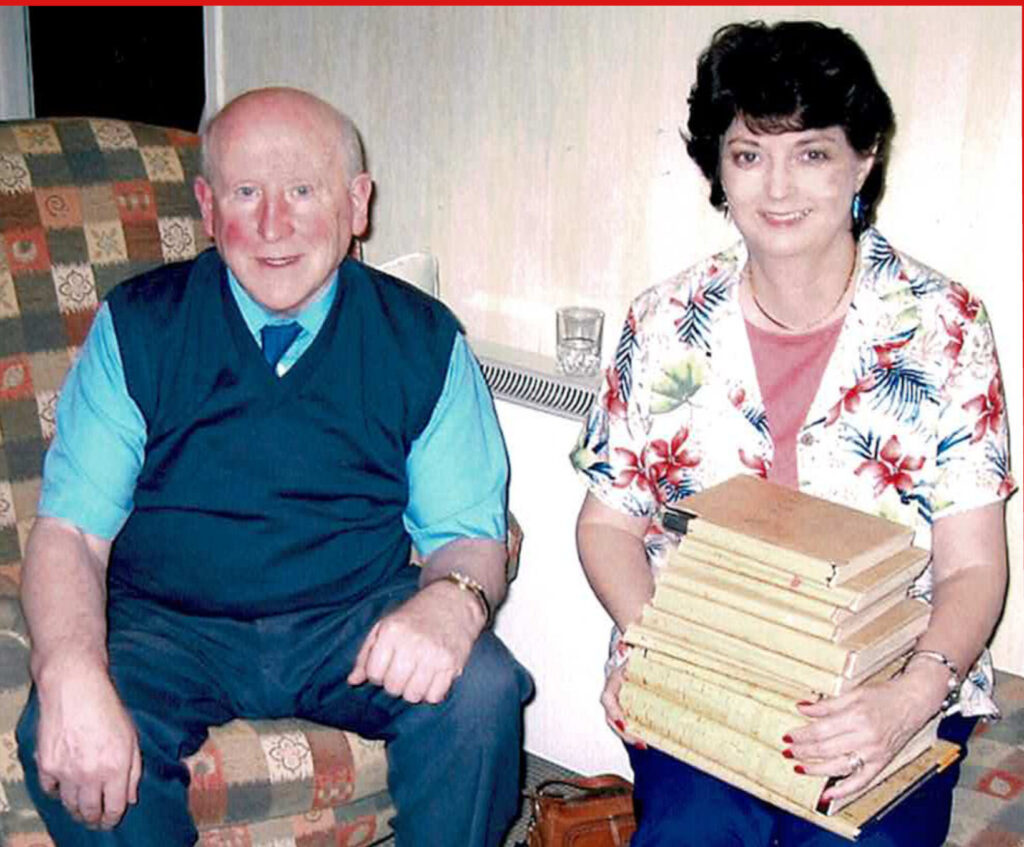
Bobby Dukelow, a retired Faith Missioner, arranged for Robert Kee to visit John Long and photocopy his father’s Journal. Mr. Long did not want the Journal to leave his home. So beginning on February 20, 2002, over 23 separate visits, Kee took the necessary equipment and scanned the handwritten original Journal pages into high-quality jpeg image files (200 dpi). The total file size was 73.5 MB. He made the Journal available on a CD, and copies were distributed to interested parties.
The Journal covers the years 1872 through 1956 when Long’s mother died. Each Journal is actually a set of several notebooks, each set containing approximately 8 to 10 notebooks. Kee scanned the years through 1927. Kee emailed the scanned documents to Cherie who finished typing them in early March 2002.
It was John Long who obtained the meeting place for Wm. Irvine to hold a mission which John Long viewed as the start of the Go-Preacher movement (aka 2×2 sect). Long wrote: “In 1895, he [Wm. Irvine] …was sent by J. G. Govan to Northern Ireland to Evangelize; and from north to Co. Clare, in the south of Ireland. While conducting a mission in Kilrush, I met him and directed him to Nenagh, where a revival began in August 1897, which afterwards formed into the Go-Preacher Testimony” (August 1897, John Long’s Journal).
On the last page of his original Journal, Long mentions that he intended to write a second book, (Journal) and he did so. The other Journal was handwritten and almost identical to the first. The copying process must have been unbelievably tedious and have taken an enormous time. His son inherited both Journals and he valued them very much.
Long stated that the original Journal was given to a Mr. Walker and remained for many years in that family. Years later, Cherie Kropp was contacted by a grandson of Mr. Walker who had seen and read some of the Journal in earlier years while it remained at his grandfather’s home. Unfortunately, the homestead was sold, possessions disbursed, and the current location of that particular copy of Long’s Journal is not known to him.
Robert discussed the subject of posting Long’s Journal on the internet, and Mr. Long enthusiastically agreed to allow it to be placed on Cherie’s website TellingTheTruth.info. Mr. Long signed a Permission Form to publish the Journal on April 23, 2002, in the presence of Robert Kee and Bobby Dukelow, representing Faith Mission. Subsequently, Cherie posted the Journal on her website TellingTheTruth.info.
In 2004, Robert Kee kindly arranged for Cherie Kropp-Ehrig and her husband to visit with Mr. and Mrs. John Long and chauffeured them to Long’s home in Ireland. Mr. Long allowed them to handle both Journal copies and gave Kropp-Ehrig his permission in writing to publish the Journal on July 28, 2004. In her book, Preserving the Truth, numerous passages are quoted from John Long’s Journal. No other historical 2×2 document has turned up with a fraction of the information contained in this Journal.
Go to John Long’s Journal on TTT.
Out of the Blue—An Australian man calls an Oklahoma woman
RE: Goodhand Pattison’s Account of the Early Days to his Son, John
When I was on vacation in Oregon in 1993, a long-time friend of my brother and his wife invited me for dinner. While we were discussing the early history of the 2×2 Sect, he asked if I knew about an old document dated 1925, titled Account of the Early Days that was written by an Irishman, Goodhand Pattison of Cloughjordan, Co. Tipperary, Ireland. I had never heard of it. He had promised not to give this account to anyone, but he agreed to read it to me aloud. It was quite lengthy, and we were up after midnight listening to him read this fascinating story.
There were a few notable statements in the Account that stayed with me. One was Wm. Irvine being called a “red-hot evangelist,” and saying, “Jesus was a common man.”
Of course, after hearing the story, I really wanted a copy for myself. I checked with everyone I knew who might possibly have heard/read it. No one had.
Out of the blue some years later, I received a phone call from a man in Australia, who identified himself as the father of a friend of mine and also the brother to another friend. Both had left meetings. I had met this man one time when I was 16, and we had not communicated since. He told me that he had recently received a copy of a very detailed account of early 2×2 history in Ireland. Would I be interested in having a copy? WOULD I EVER! He asked that I not reveal my source. I suspected it was the same account my brother’s friend had read to me.
FINALLY, the document arrived in my mailbox. I hurriedly read it looking for the “red-hot evangelist” who claimed, “Jesus was a common man.” Sure enough, it was the same account! Needless to say, I was delighted! I distributed it and also posted it on my website, TellingTheTruth.info
The document is titled Account of the Early Days by Goodhand Pattison and was written in 1925 at the suggestion of his son, John, who went to South America to preach in 1922, where he remained for over 50 years and was buried. The Account concentrates mostly on the missions held within a 20-mile radius of the town of Nenagh in County Tipperary, Ireland, where the home of Goodhand Pattison (Cloughjordan) is located. The Account covered the time period from the Winter of 1897 through the 1903 Portdadown Ireland Convention.
Pattison’s Account about the early history and development of the 2×2 Sect is one of two primary evidence documents to surface that was written by a first-hand witness and 2×2 Sect member when the history was being made. The other document is the Journal of John Long discussed above.
Account of the Early Days by Goodhand Pattison
How I chose my book title: Preserving the Truth
When I first started compiling the text for my book in 2000, I posted the chapters on my website, TellingTheTruth.info under the title, “The Real Truth about the Truth.” Later, I changed it to “The Life and Ministry of William Irvine 1863–1947.” However, I wasn’t satisfied with either of these and continued searching.
It wasn’t until September 25, 2015, that the final title for my book came to me. During our vacation to Colorado while visiting the Black Canyon of the Gunnison National Park, we watched a historical documentary* at the Visitor Center**. When we walked out, I turned to my husband and exclaimed, “NOW I know what the title of my book will be!” At that moment, it was firmly settled it in my mind, and I’ve been pleased with it ever since.
The documentary revealed how one man made it his life’s mission to preserve and protect the natural beauty of the Black Canyon. He was successful beyond his wildest dreams. It was designated as a National Park in 1999.
The Black Canyon of the Gunnison National Park is one of Colorado’s most spectacular natural wonders. Located on the western slope of the Rocky Mountains, it is renowned or its dramatic and steep cliffs that plunge down into the Gunnison River below. The canyon walls are some of the steepest in North America. The greatest depth is at Warner Point, which is 2,722 feet (about 1/2 mile; 829 km) from the Black Canyon rim to the Gunnison River below. The depth is as tall as Burj Khalifa, the tallest building in the world in Dubai, United Arab Emirates.
The narrow gorges created by the rushing river have carved intricate patterns into the rock over millions of years. Paleontology surveys have unearthed fossils of dinosaurs.
The color of the rock is not actually black; it’s called “black” because the interior is so steep, deep, and narrow that some parts receive only about 30 minutes of sunlight per day. The rest of the time it remains in a black shadow.
It is believed that the Ute Indians were the first to explore and make their homes in Black Canyon area, along its rims–-not within the steep chasm. Their name for the river was “Much Rocks, Big Water.”
The Black Canyon was considered impassable by humans. However, in 1853, Congress sent Captain John Gunnison with an expedition party to explore the area along the river. Gunnison. Although they were only able to navigate 30 of the Canyon’s 48 miles, they were able to provide the first detailed survey map. Unfortunately, during their further expedition into Utah, Capt. Gunnison and several of his men were killed by Paiute Indians. The river name was changed to Gunnison in honor of Captain John Gunnison.
In 1881, the Denver and Rio Grande Railroad (shortened to Rio Grande) began building its famous, narrow-gauge rail line inside the Black Canyon connecting towns of Gunnison and Montrose.*** The goal of the Rio Grande was to tap into the wealth and traffic coming in from the nearby rich gold, silver, lead, copper and coal mines across Colorado by connecting the remote mining towns to markets, which facilitated the Colorado industrial boom in the late 1800s.
In August 1882, the first Rio Grande train ran through the Black Canyon, following the canon for several miles. In spite of its dangerous rockslides, thousands of railroad tourists came to experience and admire the Black Canyon. For 67 years the Rio Grande carried minerals mined from surrounding areas and livestock, as well as thousands of thrilled railroad tourist Passenger service ended in 1940, with freight service ceasing in 1949, when the rails were removed. Most of the old railroad bed is now submerged under Morrow Point Reservoir. A short section is accessible from the Pine Creek Trail.
Enter Reverend Mark Thomas Warner (1889-1975), a native of Ohio. Rev. Warner arrived in Montrose, Colorado, in 1918, founded the United Presbyterian Church and remained its pastor all his life. An avid outdoorsman, hiker and nature lover, he fell in love with the Black Canyon situated 12 miles from Montrose. The Canyon had a powerful hold on him. He felt the Black Canyon was a place where many could find peace and wanted to make it accessible to others. He convinced the Montrose Lions Club to build a road to the Canyon’s rim; it was completed in 1930.
The Black Canyon became Rev. Warner’s pulpit. His goal was to preserve the natural beauty of the Black Canyon so that people all around the world would have the opportunity to enjoy and be moved by it. He also wanted to protect it for appreciation by future generations and to prevent it from being developed by man in ways that would destroy its natural beauty.
Warner began writing hundreds of letters to newspapers, businessmen and politicians throughout Colorado. On March 2, 1933, his efforts paid off. President Herbert Hoover announced the newest addition to the National Park system: The Black Canyon of the Gunnison National Monument.
Finally, 66 years later, after his death, Rev. Warner’s dream was fully realized. In 1999, 14 miles of the 48 mile canyon were redesignated as the Black Canyon of the Gunnison National Park. National Park Service reports that it has 300,000 to 400,000 visitors a year.
Rev. Mark Warner was the Pioneer of Preservation, He was the glue that brought everything together to ensure people in that day and also future generations would be able to enjoy this incredible place, full of beauty and life. It has been an inspiration to countless viewers.**
Listening to the documentary about Rev. Warner’s long-time goal, mission and efforts for preserving and protecting the Black Canyon resonated within me.
My long-time goal has been to preserve the origin and development of the Two by Two church. To protect, make available and easily accessible documents detailing its important history for present and future generations; and to prevent the historical truth from being lost or misrepresented.
And that’s the history of how I arrived at the final title for my book: Preserving the Truth.
By Cherie Kropp-Ehrig
December 18, 2025
The documentary we watched: (start at: 14.00) ~ *https://www.youtube.com/watch?v=r_ELMNXEFZI
**Sightseeing information by National Park Service ~ https://www.nps.gov/blca/index.htm
***The struggle to build a railroad through the canyon is detailed in the article “Man Against the Black Canyon,” in the Spring 1973 issue of the Colorado Historical Society’s Colorado Magazine. Read here:
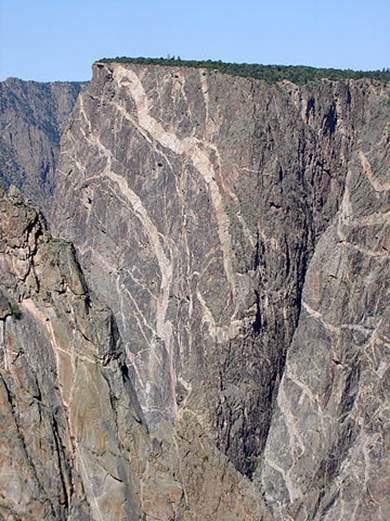
The famous “Painted Wall,” Colorado’s steepest cliff is in the Black Canyon.
[Photo courtesy Wikimedia Commons]